- March 22, 2026
- by Laxminarayan Enterprise
- Printing & Packaging - GENERAL
- 0 Comments
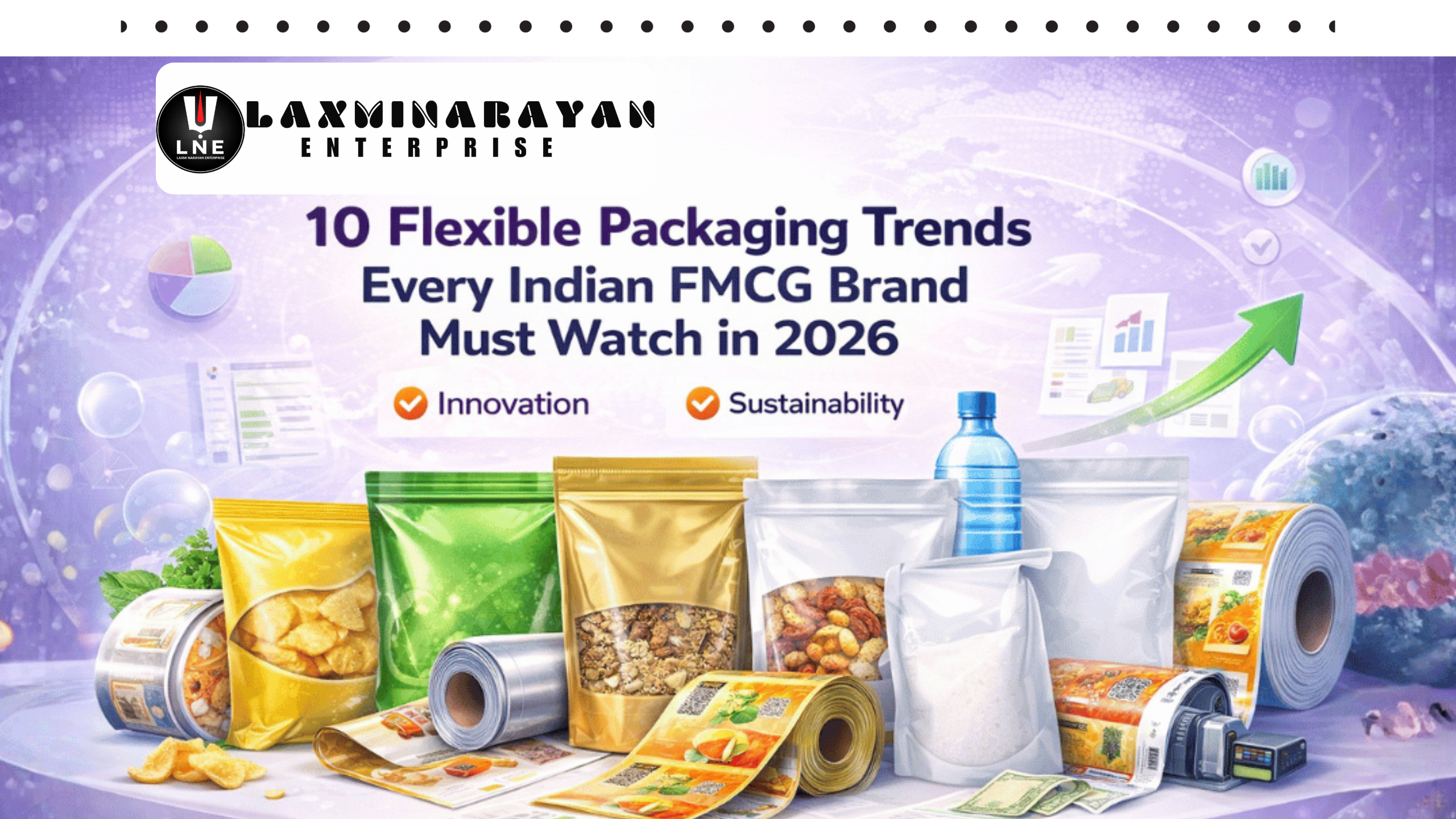
Did you know that India’s flexible packaging market is projected to grow at a staggering 13.1% CAGR between 2026 and 2030 — adding over USD 20 billion in value? If you are running an FMCG brand right now and your packaging still looks the same as it did five years ago, you are already falling behind.
The good news? Flexible packaging trends in India are creating massive opportunities for brands that act early. From eco-friendly films to resealable pouches built for quick commerce, the shift is happening fast — and brands that leverage these trends will win on shelves, in carts, and in consumer minds.
Here are the 10 flexible packaging trends every Indian FMCG brand must watch in 2026.
1. Sustainability-First: Recyclable and Mono-Material Films
In 2026, sustainability is no longer a buzzword — it is a business requirement. EPR (Extended Producer Responsibility) regulations are pushing Indian FMCG brands to shift to recyclable packaging structures. The top trend is mono-PE and mono-PP films, designed for 100% recyclability without compromising barrier performance.
Brands that print clear sustainability claims on their packs — backed by proper certification — are already seeing stronger retail placement and consumer trust. If you are still using non-recyclable laminate structures, now is the time to speak with your flexible packaging manufacturer about alternatives.
- Ask for mono-material laminate options
- Check PCR (Post-Consumer Recycled) resin availability
- Align with CPCB Extended Producer Responsibility guidelines
2. FSSAI-Compliant Food-Safe Packaging Structures
FSSAI is tightening norms around food-contact materials, migration limits, and labeling requirements. For printed pouch and laminate manufacturers, this means every film layer, adhesive, and ink must meet food-safety standards.
Brands choosing packaging partners that offer proper documentation, migration testing, and barrier certification will have a significant compliance edge as regulations tighten through 2026. Learn more about food-safe materials in our blog: Food-Safe Packaging Materials: What Every FMCG Brand Must Know.
3. E-Commerce-Ready Stand-Up Pouches
With Blinkit, Zepto, and Swiggy Instamart growing at record speed, packaging must now survive warehouse sorting, transit drops, and last-mile delivery. Stand-up pouches with high puncture-resistance, strong bottom seals, and premium zipper closures are becoming the default choice for snack, dry fruit, and FMCG brands going D2C.
Brands investing in e-commerce-ready stand-up pouches are seeing fewer returns, lower transit damage claims, and better unboxing experiences. Explore our Stand-Up & Display Packaging range to find the right structure for your product.
4. Resealable Zipper Closures for Freshness and Repeat Use
Indian households are shifting from single-use packs to larger resealable formats for snacks, masalas, dry fruits, and cereals. Resealable zipper pouches improve the consumer experience, reduce food waste at home, and encourage buying in larger quantities — which directly boosts your average order value.
This trend aligns with the growing premiumisation of Indian FMCG packaging. Read our detailed guide: Resealable Zipper Pouches: Benefits, Types & Applications for Food Brands.
5. Digital Printing for Low MOQ and Fast Launches
One of the biggest flexible packaging trends in India right now is the shift to digital printing for short runs, seasonal packs, and regional SKU variations. Digital printing eliminates expensive rotogravure cylinders, slashing upfront costs and turnaround time from weeks to days.
For FMCG startups and emerging brands launching on Amazon or quick commerce, this means you can test five flavour variants with individual pouch designs before committing to a full production run. This is a game-changer for brand agility.
6. Transparent Windows for Product Visibility
Consumers want to see what they are buying. Flexible packaging now combines high-barrier multilayer films with shaped transparent windows that showcase product quality — especially in categories like dry fruits, artisan snacks, pet food, and cereals.
Research consistently shows that transparent window packaging commands a premium price perception. Position your window to show the hero product clearly while keeping key branding visible from arm’s length on shelf.
7. Smart Packaging: QR Codes and Traceability
Smart packaging is gaining rapid traction as a flexible packaging trend in India in 2026. QR codes printed directly on pouches link consumers to product stories, authentication certificates, nutritional deep-dives, and brand loyalty programmes.
For FMCG brands in food and nutraceuticals, traceability QR codes also help meet evolving regulatory demands and build consumer confidence — especially in a post-COVID era where ingredient transparency is critical.
8. Premiumisation Through High-Barrier Laminate Structures
As India’s middle class grows, so does demand for premium packaged food products. High-barrier laminates that protect against oxygen, moisture, UV light, and aroma loss are enabling brands to charge more, extend shelf life, and reduce distributor wastage.
Multilayer flexible film structures are at the core of India’s premiumisation trend, whether you are selling organic spices, specialty coffee, or nutraceutical powders. Explore how Custom & Specialty Packaging can elevate your brand positioning.
9. Machine-Grade Roll Films for High-Speed Lines
FMCG brands scaling nationally are moving to automated filling and sealing lines. This demands flexible packaging rolls with precise thickness, consistent sealability, and anti-static properties that run smoothly at high speeds without jams or seal failures.
Choosing a flexible packaging manufacturer with in-house lamination and strict QC for machine-grade rolls eliminates costly production downtime. See our Machine-Grade Roll Packaging solutions designed for high-speed FMCG production lines.
10. Partnering with the Right Flexible Packaging Manufacturer in Kolkata
All ten of these trends are only actionable if you have the right manufacturing partner. The Indian market has many unorganised converters, but quality, compliance, and delivery consistency separate the best from the rest.
At Laxmi Narayan Enterprise, we combine in-house rotogravure printing, multilayer lamination, and strict FSSAI-aligned quality control to help FMCG brands across India upgrade their flexible packaging. From low-MOQ trial packs to high-volume national rollouts, we are equipped to scale with your brand.
Final Thoughts: Act Now Before Your Competitors Do
Flexible packaging trends in India are not waiting for anyone. The brands that upgrade to sustainable, e-commerce-ready, consumer-friendly packaging today will own shelf space and consumer loyalty tomorrow.
For a free packaging consultation, contact Laxmi Narayan Enterprise today or WhatsApp us directly for a quick quote. Share this post with an FMCG founder who needs to upgrade their packaging in 2026!
External Reference: According to Technavio’s India Flexible Packaging Market Report, the Indian flexible packaging market is expected to grow by USD 20,298 million between 2026–2030 at a CAGR of 13.1%.